Roadmap.
OpenFame is a market with public rules and a public journal today. It aims to become an open protocol that humans, agents and other clients use through the same rules, a name earned the day a third party transacts through them. This page states what is live, announced, undated and under study.
Where this came from.
OpenFame is a global resellable attention market: 100 ranked spots, each always for sale at a price its owner sets; when you're outsold, you get paid; one no-refund line on top, the Throne.
The domain openfame.app was registered by its founder on 19 May 2026; the date is in the public whois, and anyone may look it up. The site was then built over the following months, one evening at a time.
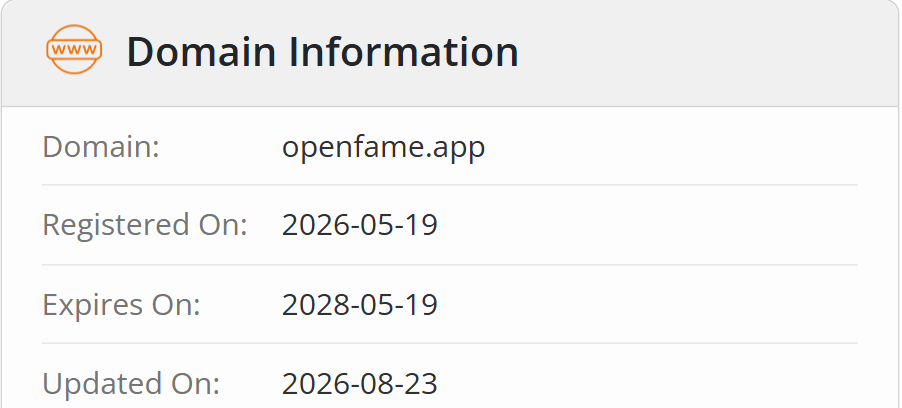
The record as anyone can look it up. The picture illustrates it; the record is the proof.
Three months later, in August 2026, a site called outbid.lol launched a single line that anyone could take by paying more than the last person, and reached a large audience within a week.
It settled the only question that mattered: people will pay to be seen, at prices that rise in public. It settled it faster than this project would have, and the credit for that is theirs.
What they built is one object, a line where the money is spent and does not come back. OpenFame has that object too: it is the Throne, it sits above everything else, and its rule is the same as theirs. Underneath it is the opposite object: one hundred places that belong to the people who hold them, priced by them, and that pay them when somebody takes one.
One market with both games in it, the one that costs and the one that pays. That is what was being built while the first question was being answered elsewhere.
The rules are public, versioned and enforced by a program on the Internet Computer whose journal anyone can read. That is what allows this site to state that the operator cannot remove a place, reorder the Board or change a price unannounced, and to be checked on it. Money moves through Stripe; the seller's share, the fees and the daily charge are parameters of the same program, so what the site says and what the money does cannot drift apart.
What is live.
What the points are.
Live. The canister awards them under public weights and the rulebook states the weights. They buy nothing today; the token page states what they will count for.
How machines read the board.
Live in version 1: a typed Candid interface, a self-describing method, the Board as JSON at a stable address, and a policy for programs written into the rules. Announced for version 2: a read-only Model Context Protocol server, so that an assistant can read the Board, quote a place and search a category directly. Read-only, because it never touches the money path; and everything it returns from a placement is text somebody paid to show, which is data and never an instruction. See the page
Where a Wall post goes.
Live. When a post's week ends it moves to the Hall of Fame, shown as it was written and no longer clickable, so that a week somebody paid for remains a week that happened.
What comes next.
Where the token stands.
Minted on 29 August 2026, and not launched. One billion $OPENFAME exist on Solana, both authorities destroyed, every token in a locked account; the address is on the token page and on @OpenFameApp, and a block explorer confirms all of it. Nothing is sold or presold, and the first distribution has no date: it will be announced before it happens. See the page
How agents will buy and resell.
Announced for version 2. A program will be able to quote, buy and resell under the same rules as a person, through keys issued to a human account first, then through its own principal once a crypto rail exists. Reading is already open; writing waits for that door, on purpose.
How an assistant will answer with the board.
Announced for version 2, before the rail. A read-only Model Context Protocol server, so that any assistant can read the Board, quote a place and search a category as a tool, with the price beside every answer. An answer engine that recommends a link owes its reader a reason; here the reason is a public price, paid by the owner and readable by anyone, which is more than any advertising network can say. Read-only, because it never touches the money path; and everything it returns from a placement is text somebody paid to show, which is data and never an instruction.
How the price of attention will be published.
Announced for version 2. One public series, computed from the journal: the board's median price per click, day by day, with the number of places sold and the sum paid, as JSON at a stable address and as a feed. It is the figure every placement already shows, kept over time, so that a journalist, a researcher or a program can cite what attention costs here without asking us.
What an owner will see of a spot.
Announced for version 2. On the account page, for each spot held: the clicks by day over the whole tenure, the countries they came from in aggregate, and what each fee period bought at the price of the moment. Aggregates only, never a visitor: the site counts a click, not a person.
How a watch will work.
Announced for version 2. An account will be able to ask to be told, by email and by nothing else, when it is outsold, when a place under a price of its choice comes free, and when the Throne is a day from its reset. Each watch is opted into by name and removed in one click, and none of it is a newsletter.
How campaigns will work.
Announced for version 2. A campaign is a time-boxed multiplier on fame points, funded from the activity-reward share of the token. None will run before its pool exists and its rules are published, and neither has happened.
Where a badge will live.
Announced for version 2. A small image an owner can place on their own site, showing their rank and linking back to their place. Served as a cached image rather than a script, so it can neither read the page it sits on nor slow it down.
What has no date.
How the revenue is proved.
Not dated, and not a version. The house's own revenue will appear on the Cashbook the day a third party verifies it, beside the figures the canister already publishes. Until then the Cashbook carries only what the journal and Stripe have realized, which is the number that is hardest to fake.
Who checks the translations.
The site is written in English first, and every string and every list exists in all fourteen languages, entry for entry, so nothing falls back to English and no page is shorter in one language than in another. No language is announced as reviewed until somebody who speaks it has read it.
Who decides what the treasury funds.
Today, the operating company, in public and with notice, under the policy on the Cashbook. Announced for version 2: the questions a rule cannot settle, what the treasury funds and what the reserve is released for, move to a vote of holders. The rules themselves stay in the canister, because a vote over a hundred places would be theatre on top of a mechanism that already binds the operator.
What is under study.
Whether the intention line becomes an action.
Under study. A spot's line says what its owner asks a visitor to do; written once more as structured data, it would say it to a program: book a call, read the documentation, try the beta, with the link to do it. An assistant could then act on a place rather than describe it. The line stays the owner's words and stays unendorsed; what would change is that a machine could read the verb.
Whether agent traffic is counted apart.
Under study, with the rail. A click by a program is not a click by a person, and a buyer judging a place by its clicks deserves to know which is which. The relay already excludes known agents from the count; the question is whether to count them in a column of their own instead, and to show both.
Whether a category gets a page.
Under study, and possibly never. Fifteen filtered views of the one Board were built and removed before launch: at the opening the Board is nearly empty, and that is two hundred and ten pages of almost nothing across fourteen languages. A category is a filter; the chips on the Board apply it, and ?category= makes one citable. A page would be worth building the day a category holds enough to read.
Whether the board ever grows.
Under study, and probably never. The canister carries a mechanism for opening further places on a schedule, up to a thousand, and the product does not use it: one hundred is the whole claim, and a claim that survives the question is worth more than a larger board. Raising the ceiling would be a rule change written in the journal before it took effect, never a silent drift.
Whether a spot can be bought for somebody else.
Under study, and not in the form it had. A place bought in another person's name obliged that person before they had agreed to anything, and gave the buyer a fee to pay until they answered. If it returns, it returns as something the recipient accepts first.
Whether the engine is offered to others.
Under study, and not before version 2 has run. The canister is a market for one board of a hundred places; the same rules could run a hundred boards for other communities, each with its own name and its own house, under one published engine. That is a different product, with a different claim, and it would be built as one: the board here stays one board, and that sentence does not change.